SPT
Driven by a doctrine of pre-emptive security, Eritrea is training fighters, managing the attrition of rivals, cultivating dependent allies and reshaping the balance of power in eastern Sudan
Eritrea’s policy in the Horn of Africa cannot easily be understood as merely defensive the response of a small state surrounded by threats. While that interpretation captures some of Asmara’s security anxieties, it overlooks the most consequential shift in its regional conduct.
Eritrea is not simply defending its borders. It is seeking to expand its political and security reach beyond them, reshaping its immediate environment to prevent the emergence of power structures that could threaten its interests or restrict its room for manoeuvre.
Eritrea can therefore be described as pursuing an expansionist regional policy not necessarily through territorial occupation or annexation, but through the extension of its influence, its definition of national security and the scope of its involvement in neighbouring states.
Asmara pushes its defensive perimeter beyond Eritrea’s formal borders, treating political and security vacuums in neighbouring countries as spaces that must be filled before they become sources of danger.
Developments in eastern Sudan must be viewed within this wider context. Sudan’s war, renewed tensions in western Tigray, relations with Ethiopia, the activities of Eritrean opposition groups and security in the Red Sea are interconnected elements in Asmara’s strategic calculations. The more fragile Eritrea’s neighbours become, the greater the opportunity for it to expand its influence.
Pre-emptive expansion and strategic depth
Eritrea’s approach is rooted in what might be described as “pre-emptive security expansion”: rather than waiting for a threat to reach its borders, Asmara seeks to intervene in the surrounding arena and reshape potential sources of danger before they become direct threats.
Under this doctrine, a border is no longer simply a line separating two states. It becomes part of a broader security zone extending deep into neighbouring territory.
Political decisions in a neighbouring country, the composition of its armed forces, relations among its social groups, the presence of Eritrean opposition movements, and even trade routes, smuggling networks and population movements can all become part of Asmara’s definition of national security.
Every state has the right to protect its territory. But national security loses its defensive character when it is no longer geographically bounded, and when every political change in a neighbouring country becomes justification for intervention or for rearranging its internal balance of power.
At that point, a state is no longer simply protecting its frontiers. It is reshaping its neighbourhood to make it less capable of generating political or military power independent of its influence.
This is the essence of the expansionist tendency in Eritrean policy. It is not necessarily about exercising direct control over territory, but about influencing the conditions under which political and military actors operate, shaping the forces active within that territory and preventing the rise of power centres beyond Asmara’s reach.
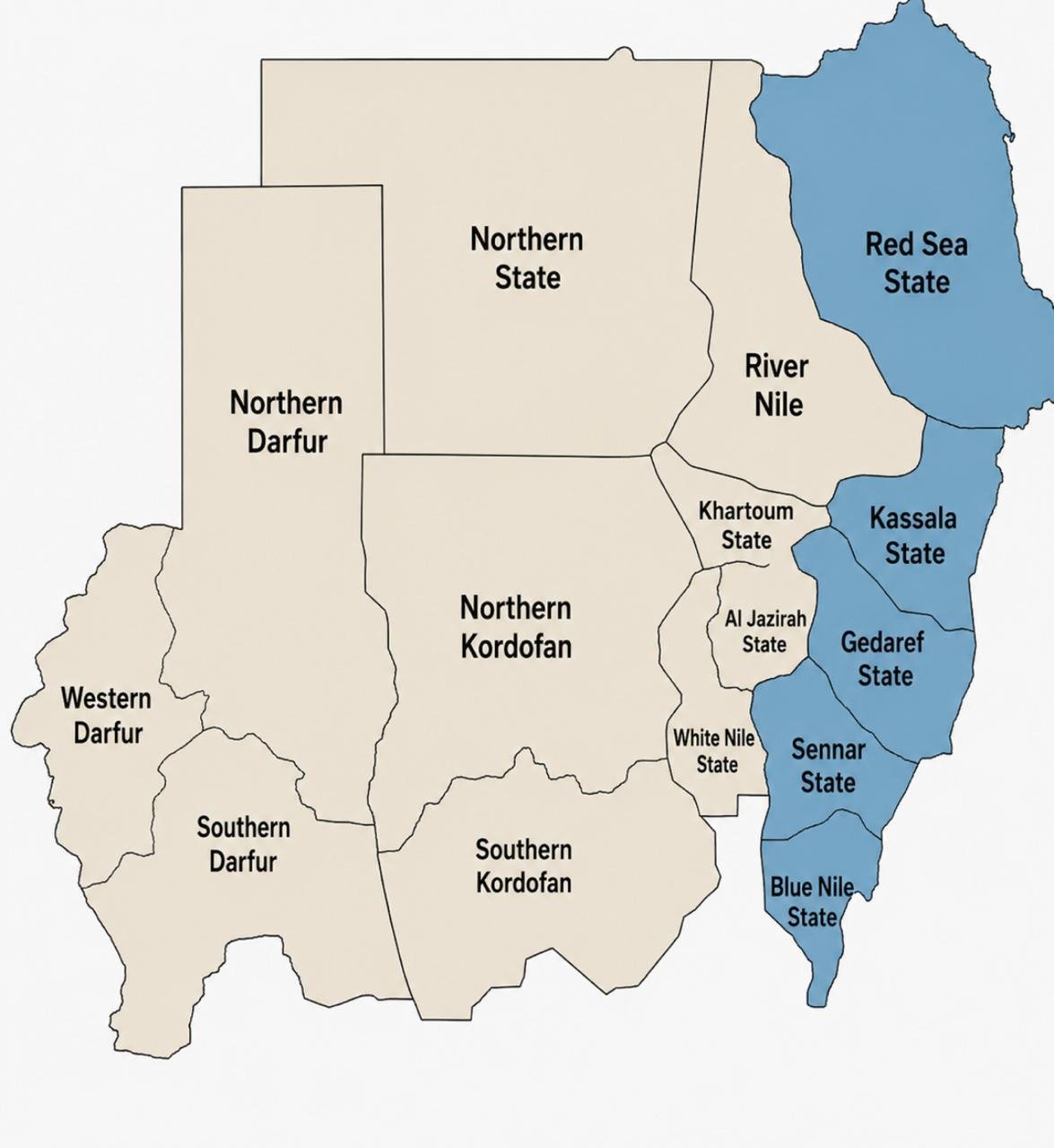
This policy is particularly significant in eastern Sudan, where the border with Eritrea stretches for more than 600km. Communities, trade, migration and smuggling routes overlap across both sides.
Asmara has not treated eastern Sudan simply as a region belonging to a neighbouring state with which it shares a border. Instead, it has increasingly viewed the region as part of Eritrea’s strategic depth.
The weakness of the Sudanese state has facilitated this expansion. As the central government’s ability to administer peripheral regions declined, tribal, local and political structures retained their influence. Some local leaders and groups became potential channels for mobilisation, political pressure and negotiation.
Asmara did not need to build influence from scratch. It found an existing social and political landscape in which relationships could be cultivated, repurposed and connected to cross-border political and security networks.
The question for Eritrea is therefore not only who controls eastern Sudan, but who can influence the forces governing it, their relationship with Sudan’s political centre and the security environment surrounding the Eritrean border.
Sudan’s war and the expansion of influence
The outbreak of war in Sudan on 15 April 2023 marked a turning point in Eritrea’s role. It enabled Asmara to move beyond political influence and local relationships towards more direct security and military involvement.
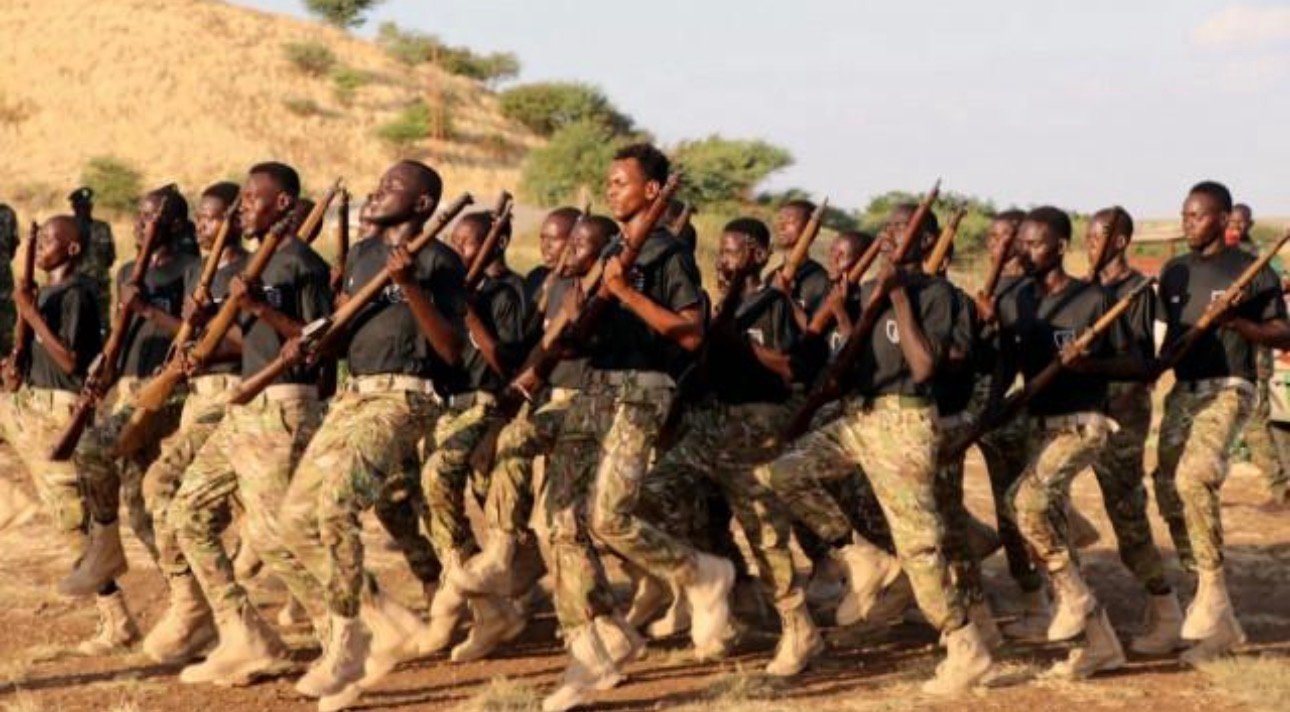
This has included training Sudanese fighters and hosting armed formations on Eritrean territory, among them groups from eastern Sudan and Beja formations allied with the Sudanese Armed Forces.
The importance of these training camps extends beyond their immediate military function. Training Sudanese forces inside Eritrea creates direct relationships between Asmara and power centres that may wield political and security influence in eastern Sudan during the war and after it ends.
It also gives Eritrea a channel through which to influence the region’s evolving power structure, turning military assistance into an instrument of political leverage rather than simply a contribution to a battlefield campaign.
This illustrates a central feature of Eritrea’s expansionist policy: using the immediate requirements of war to build long-term influence.
An armed group that depends on training, weapons and logistical support enters a relationship that may outlast the conflict in which that dependence developed. As the war continues, its dependence on the supporting state deepens. Military assistance can therefore be transformed from a temporary instrument into political and security capital that Asmara can draw upon later.
The war has also weakened Sudanese state institutions, fuelled a race to establish new forces and alliances, expanded the movement of weapons and combatants, and drawn regional actors more deeply into Sudan’s internal affairs.
In this environment, Asmara has found an opportunity to construct what could be called a “forward security belt”.
That belt does not end at Eritrea’s border. It consists of relationships with armed and local groups, training and weapons programmes, political and security contacts, connections with local administrations and leaders, and networks that may be activated to influence Sudanese affairs when required.
A distinction must therefore be drawn between securing a border as a defensive policy and reshaping the political and military balance inside a neighbouring country to protect another state’s security interests.
If Eritrea’s security belt develops into a network of armed groups and political loyalties, it ceases to function merely as a buffer protecting Eritrea. It becomes an extension of Eritrean influence inside Sudan.
Wearing down adversaries and allies
Eritrea’s strategy does not necessarily require every ally to achieve outright victory or every adversary to suffer total defeat. In a complicated regional environment, managing the balance of power may be more effective than producing a decisive outcome.
An exhausted adversary is less capable of threatening Asmara, while an ally that remains dependent on Eritrean support is less capable of pursuing an independent course.
The objective is not to allow an ally to collapse, since its collapse could create an uncontrollable vacuum. Nor is it necessarily desirable for that ally to become strong and autonomous, because its strength may eventually create competition.
The environment most conducive to influence is one in which allies remain capable of fighting but continue to need external support, while adversaries retain enough strength to be worn down but not enough to achieve victory.
This equation helps explain Eritrea’s preference for managing conflicts rather than resolving them, preserving room for manoeuvre rather than embracing settlements that might produce a new and autonomous regional balance.
If Eritrea’s sole objective were to prevent threats, a stable Sudanese state, capable institutions, controlled borders and a national army holding a monopoly over the use of force would appear to serve Asmara’s interests.
Yet a stable state does not necessarily provide the most favourable environment for a model of influence built on direct relations with local forces.
A strong state has functioning institutions, centralised decision-making and an identifiable foreign policy. A fragile state creates openings for armed groups, local leaders, security networks, intermediaries and regional powers.
This produces a central paradox: the weakness of a neighbouring state can become a source of strength for a government adept at managing political and security vacuums.
This does not mean that Asmara created the fragility of Sudan or Ethiopia. Both countries have their own internal crises and historical contradictions. But an expansionist policy can exploit that fragility rather than contribute to addressing its causes. A weak neighbouring country consequently becomes an arena for influence, rather than simply another sovereign state.
Containing the opposition and the Tigray connection
Eritrea’s conduct cannot be separated from the government’s anxiety over opposition movements. For Asmara, political confrontation does not end at the national border.
Neighbouring countries can provide opposition groups with space to organise, communicate and obtain support. Controlling the surrounding environment therefore becomes an extension of domestic political control.
Asmara’s security calculations bring together opposition activities, borders, armed groups and political mobilisation. Every independent social space can be viewed as a potential security concern, every external political relationship as a possible threat and every area beyond Eritrean influence as territory to be contained.
This is especially important in eastern Sudan because of the political and social relationships that cross the border. Extending Eritrean influence in the region therefore serves more than the objective of monitoring the frontier. It also helps restrict the regional space in which Eritrean opposition groups might operate.
External expansion, in this sense, becomes another face of internal political control.
Eritrea’s security expansion in Sudan also cannot be understood separately from developments in northern Ethiopia.
The areas around Humera and Shiraro sit within a highly sensitive frontier zone linking Sudan, Eritrea and Ethiopia. Here, borders intersect with trade routes, population movements, smuggling networks and armed conflict.
The resurgence of tensions in western Tigray in August 2026 has returned this geography to the forefront of regional calculations.
The unresolved legacy of the Tigray war includes disputed territories, military arrangements, the return of displaced people, relations between Ethiopia’s federal government and the Tigray region, and the consequences of Eritrea’s previous military involvement in the conflict.
For Asmara, western Tigray is not merely an internal Ethiopian issue. The more fragile Ethiopia’s western frontier becomes, the more valuable eastern Sudan becomes as strategic depth.
The closer eastern Sudan is tied to forces that are friendly towards Eritrea or at least not hostile to it the greater Asmara’s room for manoeuvre in responding to developments in Ethiopia or renewed activity by Eritrean opposition groups.
Three security theatres consequently converge: Eritrea’s western border, eastern Sudan and western Tigray. The Red Sea provides the broader strategic setting within which these theatres interact.
After the war: a test of Sudanese sovereignty
Eritrea has developed an ability to generate influence through security instruments, direct relations with local actors, conflict management and the exploitation of vacuums created by neighbouring states’ fragility.
This gives Asmara regional weight disproportionate to Eritrea’s size and material resources, but at a potentially high cost to regional stability.
Security influence rarely remains confined to security. When a state establishes relationships with armed groups, builds networks of loyalty, opens direct channels to local leaders and connects military support to political relationships, that influence gradually crosses into the political sphere.
This does not necessarily mean that Asmara intends to impose direct administration over Sudanese territory. It does, however, mean that Eritrea is extending its decision-making reach into an arena that should fall within the sovereign authority of another state.
Eastern Sudan has therefore become a critical test of Sudanese sovereignty.
If Sudan’s war continues alongside escalating tensions in north-western Ethiopia, eastern Sudan could increasingly become both a buffer zone and an arena for regional security competition.
The first danger is the further militarisation of the east through growing reliance on local forces and armed groups rather than state institutions.
The second is the integration of local security into regional conflicts, allowing developments in Tigray and Ethiopian-Eritrean relations to directly reshape alliances inside Sudan.
The third is the creation of armed power centres that may be difficult to dismantle after the war.
The longer-term danger is that eastern Sudan could evolve into a permanent regional sphere of influence, where a fragile Sudanese state coexists with political, military and security networks connected to foreign powers.
Ending the war would then be insufficient to rebuild the state, because the networks created during the conflict would have developed into entrenched interests.
Sudan’s war has allowed Asmara to extend its security doctrine from the border into Sudan’s interior, from military affairs into local politics, and from protecting its frontier to influencing the balance of power in eastern Sudan.
At the same time, developments in western Tigray have revived an older geography of conflict, with the Red Sea continuing to form its wider strategic backdrop.
The strands of Eritrean policy converge around a single equation: pre-emptive expansion beyond the border, the exhaustion of adversaries, the continued dependence of allies, the containment of opposition groups and the exploitation of neighbouring fragility to create strategic depth.
The question is no longer whether Eritrea has the right to protect its borders. Every state does. The real question is whether Asmara wants secure borders or a neighbourhood incapable of producing political and military power independent of its calculations.
If Eritrea’s security depends on weakening its surrounding environment, then this is no longer a conventional defensive policy. It is an expansionist model based on managing neighbouring countries from beyond Eritrea’s own borders.
The problem is not that Eritrea is seeking security. It is that, under this approach, Asmara’s pursuit of security may itself become part of the region’s enduring insecurity.