SPT
As concerns grow over the situation of Christians in Sudan, church reports and data reveal violations targeting Christian places of worship and causing large-scale displacement, particularly from the capital, Khartoum. This comes amid the rising influence of hardline Islamist currents linked to the former regime during the ongoing war, adding a complex religious dimension to the country’s security landscape.
According to special sources, authorities in Port Sudan dominated by Islamists have demolished 13 churches and caused the displacement of more than 35,000 Christians from the capital Khartoum since the Sudanese army regained control of the capital in March 2025 until now, the sources told Sky News Arabia.
The sources explained that the demolitions were carried out by the Khartoum State Security Committee, which is dominated by Islamists and remnants of the former regime, and is headed by Khartoum Governor Ahmed Osman Hamza, an Islamist and a prominent figure of the former regime, according to the sources.
The demolitions were carried out under the pretext of removing informal settlements, most of which are located on the outskirts of the capital and are inhabited by marginalized communities and displaced people from the Nuba Mountains and Blue Nile regions, in addition to some South Sudanese. Despite being built with rudimentary and simple materials, these churches continued to perform their religious duties.
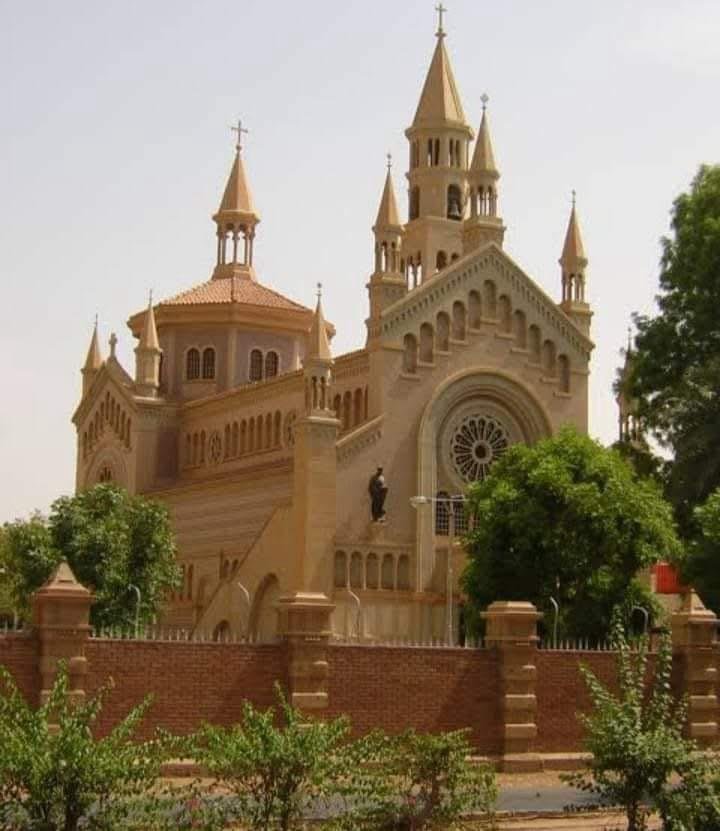
In a striking development, two churches in the city of Port Sudan were targeted shortly before Christmas, in what church sources described as a coordinated attack. Red paint was used to write the Islamic declaration of faith “There is no god but God, and Muhammad is the Messenger of God” on the walls of the Sudanese Evangelical Presbyterian Church, along with the Quranic verse: “There is no deity except Him, Lord of the Great Throne.” Meanwhile, the phrase “God is One” was written on the outer wall of the Orthodox Church.
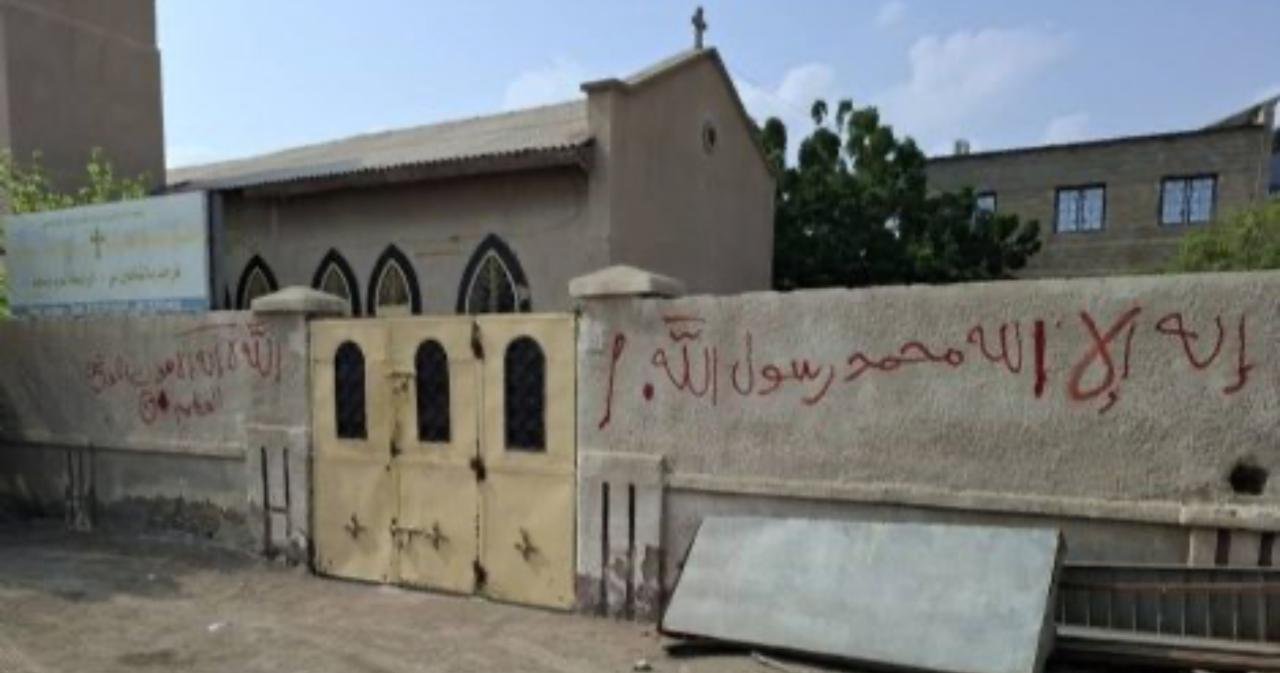
The two churches, among the oldest Christian places of worship in the coastal city, are located in the heart of Port Sudan’s market, opposite the police station and near government administrative buildings, where the government relocated, including the leadership of the Sudanese army, following the outbreak of war with the Rapid Support Forces on April 15, 2023.
Despite the timing and central location of the two incidents occurring in broad daylight and in a densely populated area local authorities, including security agencies, have so far taken no announced measures to protect churches or to open investigations into the incident.
The city’s police declined to comment to SPT on what occurred.
In testimony from the scene, a citizen who was working near the location of the incidents said:
“I was present at the time of the incident and saw the vehicle. It was a white Toyota.”
He added:
“Thank God they stopped at painting and did not blow up the two churches. Port Sudan is now full of extremists brought by the war, most of whom are armed and fighting alongside the army. Our city did not know such scenes before the war.”
In a related context, about two weeks ago specifically on Christmas Day, December 25, 2025 the Sudanese army carried out a drone strike targeting the village of Julud in the Nuba Mountains region of South Kordofan State while worshippers were gathered to celebrate the holiday, resulting in 31 people killed or injured.
This was preceded by the killing and injury of dozens of civilians, including male and female students, as a result of a drone strike carried out by the Sudanese army using two drones targeting a health center in the Komo area of Heiban County in the Nuba Mountains. The center is considered one of the main facilities frequented by Christian school students, according to eyewitnesses and local officials.
Estimates indicate that Christians make up about 45% of the population of the Nuba Mountains, while the rest of the population practices Islam and other traditional local beliefs.
The Komo area is located about 10 kilometers east of Kauda, the stronghold of the Sudan People’s Liberation Movement, led by Abdelaziz al-Hilu.
According to statistics issued by the SPLM on December 1, the death toll rose to 46 people, including 19 male and female students, 10 men, 9 women, and 8 children, while the number of wounded reached 22, including 12 men, 8 women, and two children.
In a powerful testimony from the site of the attack, Rebecca Toto, a resident of the Komo area, said:
“I came to the health center for treatment when we were suddenly struck by the sound of an explosion. When we went outside, we found a large number of injured civilians and school students. While people were trying to help them, the second strike came and killed many more. The number of casualties rose horrifically, especially among students, women, and children most of them Christians.”
Zakharia Kaluka, the father of Martha (12 years old), who was killed in the shelling, said:
“We rushed to the site of the explosion, and I never imagined that my daughter would be among the victims. I found her body in the yard outside the health center. I later learned that she had felt unwell at school and was given medical permission to visit the center. I thought she was still at school.”
Kaka Youssef, who lost her son in the attack, said:
“Over years of war, I lost my uncle and my brother, and now I lose my son. It seems that the fate of the women in my family is to give birth to children whom wars take away, as happened to my grandmother and my mother before me.”
For his part, Jatigi Amoja Dalman, Head of the Media Committee of the National Liberation Council of the SPLM governing the Nuba Mountains, told Sky News Arabia:
“The Port Sudan regime is a direct extension of the former Islamic regime led by Omar al-Bashir, and it systematically targets civilian life. The targeting of the Komo center, which provides contracted medical care for students, confirms this pattern.”
He added:
“The regime has continued to target churches, hospitals, schools, places of worship, NGO offices, and humanitarian aid trucks, forcing residents to seek refuge in trenches and caves.”
Dalman noted that attacks on schools aim to “empty them of students and push them northward toward displacement camps, where they are re-engineered within an Arab-Islamic culture.
The targeting of Christians in Sudan began in 1989 with the Islamists’ seizure of power through Omar al-Bashir’s coup, leading to a massive wave of emigration abroad, particularly among Copts and Greeks, due to restrictions on religious freedoms.
These restrictions included banning the construction of churches, confiscating church complex properties, harassment in the practice of religious rituals, the removal of Christian education from school curricula and the refusal to recognize it sometimes abolishing it altogether along with educational restrictions that included canceling Sunday holidays and forcing some students to convert to Islam in order to obtain university opportunities.
During three decades of Islamist rule, the state did not officially approve the construction of a single church, with the last permit dating back to 1987. Although former Minister of Religious Affairs Nasr al-Din Mufreh announced approval for the construction of 14 churches in 2020, the October 25, 2021 coup halted these approvals.
In the absence of official statistics, the number of Christians is estimated at around two million people, approximately 4% of the population. Sudan remained on the list of countries violating religious freedoms until it was removed in 2019 during the transitional period led by Prime Minister Abdalla Hamdok, which saw the approval of legal amendments in July 2020 that strengthened the rights of non-Muslims.
The reality of Christians in Sudan over the past decades reflects a systematic pattern of restrictions on religious freedoms, particularly during Islamist rule the Sudanese Islamic Movement (the Muslim Brotherhood), popularly known in Sudan as the “Kizan.”
Despite relative improvement during the transitional period, the military coup backed by Islamists has returned the issue of religious freedom to a state of concern and uncertainty.
Televised report broadcast by Sky News Arabia (below):