

Report: SPT
In the heart of Khartoum, where the noise of markets once blended with the voices of passersby and the roar of vehicles, a heavy silence now prevails, pierced only by the whistle of the wind through destroyed buildings. The capital, which for decades represented the political, economic, and cultural center of Sudan, is today described as a “contaminated city” amid accusations of chemical weapons use in the war a war that began in Khartoum before spreading to other conflict zones in the country.
While authorities in Port Sudan speak of a plan to establish an alternative administrative capital, testimonies from doctors, displaced people, and local leaders reveal an unprecedented humanitarian and health catastrophe.
Controversial Statements from Army Leaders
In the latter half of last year, General Abdel Fattah al-Burhan, head of the Sovereign Council, appeared in a video broadcast by army media, addressing his soldiers:
“Do not worry. We will defeat the Rapid Support Forces. Either they retreat and leave Khartoum, or we will be forced to use lethal force.”
Observers later interpreted his remarks as a direct reference to the possible use of chemical weapons. Months later, on April 24, the U.S. government officially announced that the Sudanese army had used chemical weapons in its war against the Rapid Support Forces, which erupted on April 15, 2023. Washington subsequently imposed sanctions in May.
In October, the name of Lieutenant General Yasser al-Atta, the third-highest figure in the army’s command, surfaced when he addressed troops at the Karri military base in Omdurman, declaring:
“We will use as much of the hidden power as the Commander allows.”
Later that year, Dr. Mona Ali Mohamed, Secretary-General of the Supreme Council for Environment, stated during a training workshop on chemical hazards – held at the Customs Building in Port Sudan- that Khartoum State had suffered from serious chemical contamination. She quickly clarified, however, that the contamination resulted – in her words – from Rapid Support Forces targeting factories in Khartoum.
Her remarks sparked widespread ridicule, with observers describing them as an attempt to pave the way for covering up crimes committed by the army, militias, and allied Islamist battalions.
A retired officer went further, describing her comments as “participation in the crime,” explaining:
“Most of the major factories in Khartoum were bombed and destroyed by air strikes in the first month of the war. And the Rapid Support Forces were in control of the capital. could they really have killed themselves?”
The officer confirmed he had received information from former colleagues in service indicating that the army had used chemical weapons on several occasions, particularly in Khartoum and Darfur.
Khartoum Off the Agenda
Until recently, Khartoum had not been excluded from the military authorities’ plans. The army controlled government, operating temporarily from Port Sudan, was working on a plan to rehabilitate the capital, particularly government headquarters, in preparation for the return of officials and civilians. To that end, a committee was formed under the leadership of General Ibrahim Jaber, the fourth-ranking figure in the military hierarchy.
On July 1, Jaber traveled to Khartoum to oversee arrangements. However, just one week after his arrival, on July 20, he issued a decision :
Ordering the complete closure of central Khartoum, relocating ministries, the presidential palace, and army headquarters to alternative sites in southern Khartoum, Bahri, and Omdurman.
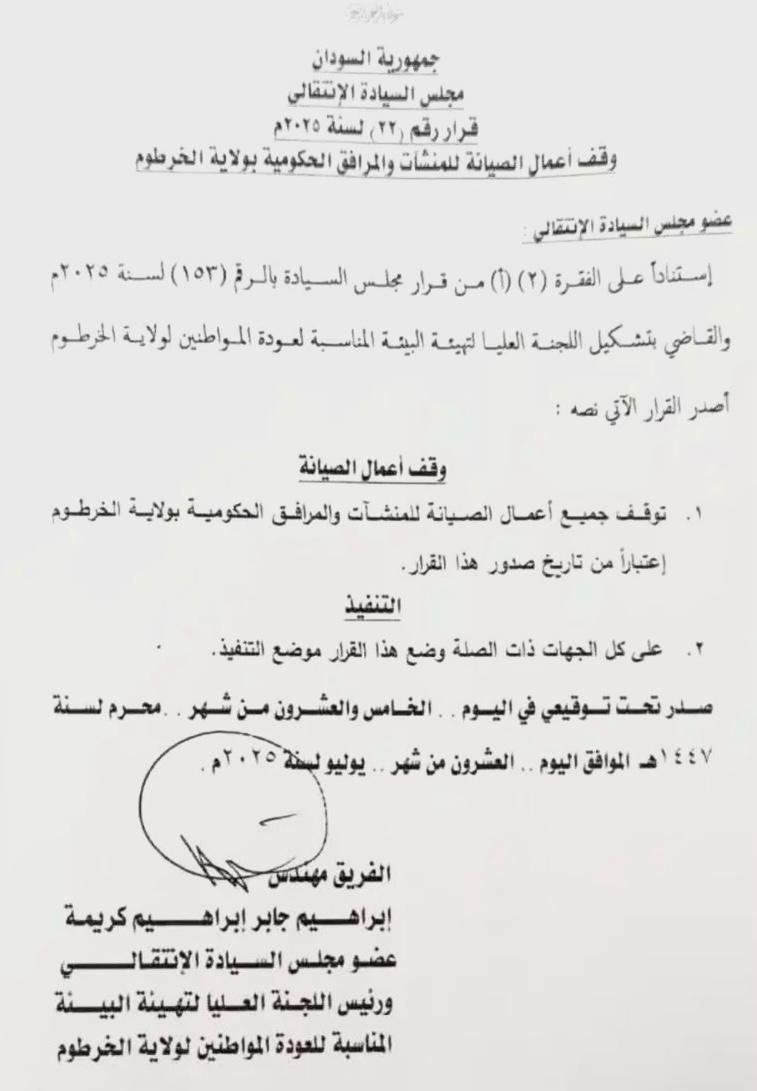
The decision did not come out of nowhere. Field testimonies confirm that vast areas of central Khartoum stretching from Nile Street in the north to Al-Qurashi Park in the south had become uninhabitable after being struck with internationally banned weapons, leaving the area environmentally and medically “contaminated.”
Testimonies from Former Soldiers
Accounts from former soldiers add an even darker dimension. Two ex-members of the Rapid Support Forces, who were stationed at the Republican Palace, told SPT from Nyala, where they currently reside, that several of their comrades had suffered sudden paralysis and lost the ability to move while stationed inside the palace, prior to the RSF’s withdrawal from the site in March 2025.
Covering Up a Chemical Crime
Medical and retired military sources confirmed to SPT that Khartoum has effectively become a “contaminated city.” They said the army, influenced by figures tied to the Islamist movement , deliberately concealed the reality of chemical weapons use through symbolic initiatives and staged activities intended to create the impression that commercial life was returning to normal.
One source explained that authorities had invited a number of merchants to reopen shops on Al-Hurriya Street in early July. Some appeared briefly, but quickly disappeared again, as none were able to actually resume business due to the area’s unlivable conditions.
Concerns extend beyond government buildings to private homes and commercial properties. A merchant now living in Cairo told SPT that the authorities have no legal right to prevent owners from accessing their properties, “unless there is an imminent danger.” He added:
“The army knows very well that the area is contaminated with toxic gases. That is why it prevents people from returning.”
North Darfur: Chemical Weapons a Reality Among Civilians
Darfur, long the epicenter of Sudan’s wars, has once again borne the heaviest toll in this conflict. Airstrikes by Sudanese army aircraft not only targeted residential areas and killed civilians but also struck pastoral zones, destroying water wells and wiping out thousands of livestock and camels.
A community leader from the Ziyadiya tribe in the town of Kuma, North Darfur, told SPT:
“I have witnessed many conflicts and wars in Darfur before, but never anything like this. I don’t know what chemical weapons are, nor have I seen or heard of them before, but what the army’s planes used against us in Kuma, if not chemical, was demonic. Many people died suddenly while standing on their feet.”
He added:
“We saw black ash unlike anything we had ever seen. Animals went blind, trees collapsed, and water wells were completely contaminated. It was the first time we witnessed this kind of bomb.”
Musa Marah, a volunteer activist in Kuma’s emergency room, said the town had recorded sudden deaths and strange illnesses among civilians, including skin blisters and eye pain, as well as unusual phenomena such as animals losing hair and suffering skin lesions.
He also noted that mysterious illnesses were spreading among displaced people sheltering in schools in Kuma – particularly Al-Farouq and Imam Ali – which had themselves been repeatedly bombed by army aircraft.
Kuma is among the most heavily bombed areas in North Darfur, enduring 173 air raids, according to emergency room statistics. These strikes killed hundreds of civilians, decimated thousands of livestock and camels, and destroyed vital infrastructure and water sources.
Mellit: Mysterious Miscarriages Linked to Bombing
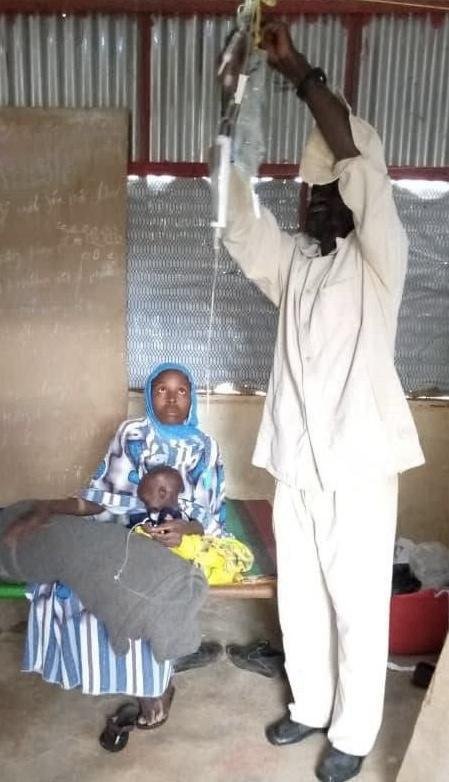
In the town of Mellit, North Darfur, disturbing medical patterns have emerged, including a surge in miscarriages among pregnant women.
Dr. Mohamed Ali Masbal, medical director of Mellit Hospital, told SPT:
“The hospital has received dozens of cases of women who miscarried without clear cause, and the phenomenon continues to this day.”
He added that the hospital operates under extremely difficult conditions, lacking medical equipment, supplies, and personnel, all under the constant threat of aerial bombardment by army planes.
Masbal suggested that the cases were likely linked to munitions dropped on the town, which he said “often contain chemical weapons.”
Conclusion
Amid this flood of testimonies, medical reports, and eyewitness accounts pointing to the likely use of chemical weapons in Khartoum and other regions, the urgency grows for an independent, transparent international investigation to uncover the truth, document violations, and hold perpetrators accountable in order to protect civilians and safeguard the very right to life in Sudan.